Hotline: 0247 300 2225
 Email: info@opl.vn
In industrial logistics operations, aluminum ingot transportation requires careful consideration of load capacity, transportation vehicles, routes, and pickup and delivery plans. Particularly for large-volume shipments, selecting a suitable transportation plan not only helps businesses optimize logistics costs but also contributes to ensuring raw material supply schedules and maintaining continuity in production and business operations.
An effective aluminum ingot transportation plan is determined not only by freight rates but also requires a comprehensive assessment of multiple factors. Below are 05 important factors businesses need to consider when developing and selecting transportation solutions.
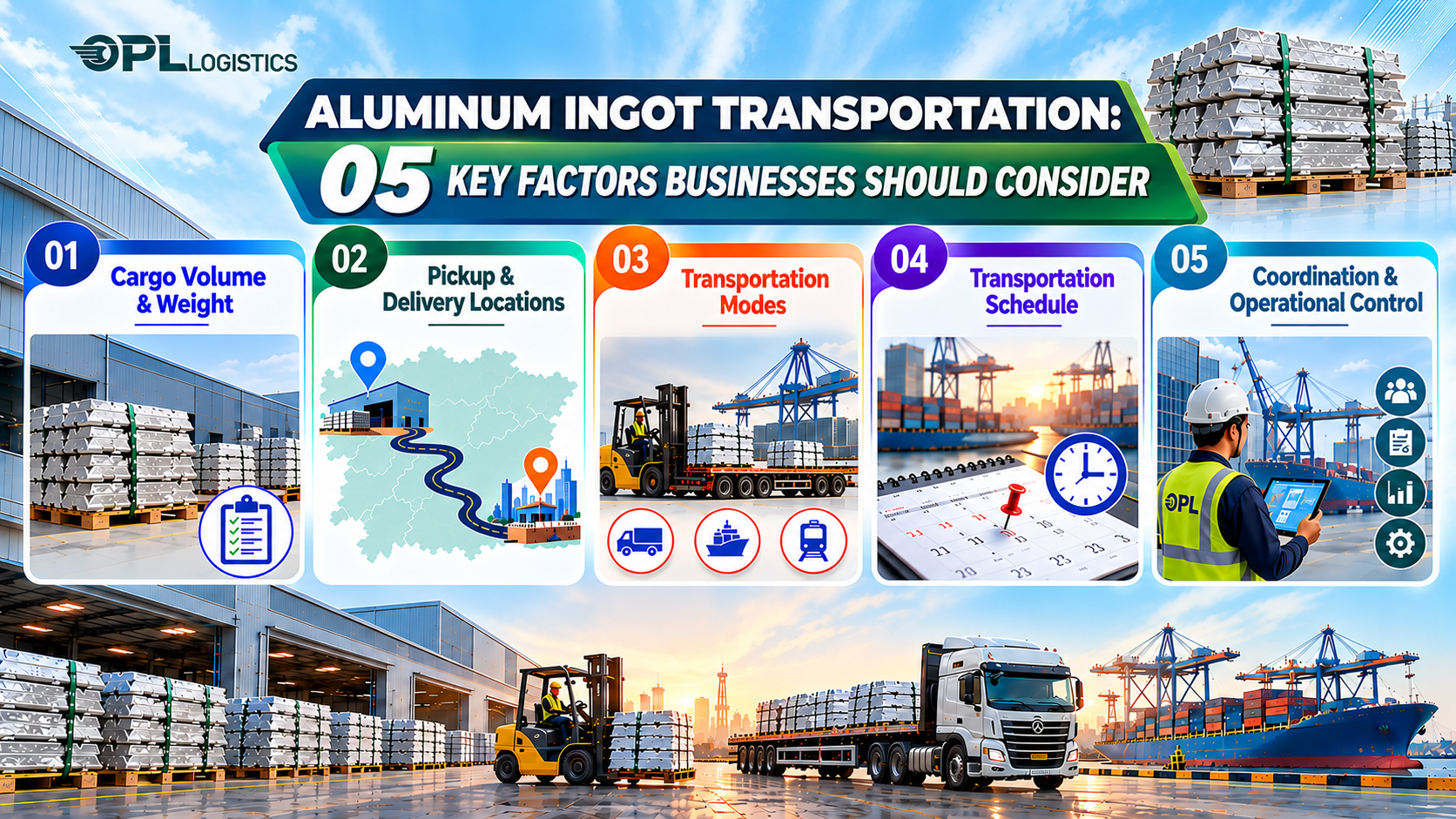
1. Cargo volume and weight – The basis for transportation planning
Aluminum ingots are high-density cargo, typically packed into bundles for convenient storage, loading, unloading, and transportation. Clearly identifying cargo characteristics from the outset provides the basis for optimizing transportation capacity, arranging suitable vehicles, and minimizing additional costs.
Key factors businesses need to consider include:
- Cargo volume & packaging specifications: Determine the total cargo volume, the weight of each aluminum ingot bundle, and packaging specifications.
- Load distribution: Calculate the number of vehicle trips required and distribute cargo in accordance with the permissible load capacity of each vehicle.
- Operational safety: Control load distribution to avoid overloading or unbalanced loads that may affect safety during transportation.
Accurately calculating cargo volume and weight helps businesses effectively utilize vehicle capacity, minimize additional costs, and ensure operational safety.
2. Pickup and delivery locations – Optimizing routes and operating conditions
The efficiency of aluminum ingot transportation depends not only on geographical distance but is also affected by transportation infrastructure conditions and accessibility at pickup and delivery locations.
Businesses need to comprehensively assess the following factors:
- Infrastructure conditions: Survey the locations of factories, warehouses, seaports, or industrial parks; check road and bridge load restrictions and accessibility for trucks and container trucks.
- Loading and unloading capacity: Check lifting equipment, operating space, and the capacity to receive and handle cargo at pickup and delivery locations.
- Route selection: For long-distance routes or routes involving multiple delivery points, it is necessary to calculate travel time, traffic restrictions, and multimodal transportation connectivity.
A shorter route is not necessarily the most cost-effective option. A comprehensive assessment of operating conditions helps businesses minimize waiting times, reduce risks, and improve transportation efficiency throughout the entire journey.
3. Transportation vehicles – Suitability for load capacity and cargo characteristics
Selecting transportation vehicles is an important factor that directly affects the costs, schedules, and safety of aluminum ingot transportation. Depending on cargo volume, transportation distance, and infrastructure conditions, businesses may choose road transportation (cargo trucks or tractor units) or combine road transportation with inland waterway and sea transportation to take advantage of each transportation mode.
In addition to carrying capacity, vehicles must meet requirements regarding permissible load capacity, technical conditions, and loading and unloading operations. Cargo arrangement, load distribution, lashing, and securing must also be carried out in accordance with proper procedures to minimize the risk of cargo shifting, impact, or unsafe conditions during transportation.
The optimal transportation vehicle is not necessarily the one with the highest load capacity, but the one most suitable for cargo characteristics, transportation routes, and actual operating requirements.
4. Transportation schedule – Ensuring supply chain continuity
As one of the important input materials for many manufacturing industries, aluminum ingot transportation schedules directly affect businesses’ warehouse receiving plans, raw material inventory, and production line operations.
To ensure pickup and delivery schedules, transportation plans need to focus on:
- Transportation planning: Clearly determine cargo pickup times, transportation routes, and delivery times.
- Vehicle coordination: For large-volume orders, delivery schedules should be reasonably allocated across different batches to avoid too many vehicles arriving at the same time and causing congestion at warehouses.
- Proactive contingency planning: Anticipate changes in traffic conditions, weather, or operating schedules to make timely adjustments to transportation plans.
Effective schedule control not only helps ensure on-time delivery but also contributes to reducing storage costs, minimizing production disruptions, and improving supply chain stability.
5. Coordination and operational control – ensuring efficiency throughout the process
Aluminum ingot transportation, particularly for large-volume shipments, requires coordinated cooperation among parties involved in the logistics chain: cargo owners, transportation providers, warehouses, and cargo recipients.
In practice, a transportation plan with competitive freight rates may still result in higher overall costs if coordination is ineffective, leading to vehicles waiting for cargo, delayed pickup and delivery, or repeated adjustments to transportation plans.
Therefore, businesses should prioritize working with logistics providers capable of:
- Monitoring and updating transportation progress: Tracking transportation journeys, providing timely information, and maintaining communication among relevant parties.
- Handling unexpected situations: Proactively coordinating and adjusting transportation plans when changes occur to minimize their impact on transportation schedules and costs.
Logistics capabilities are reflected not only in the ability to transport goods but also in the effectiveness of connectivity, coordination, and control throughout every stage of operations.
Opl logistics – An aluminum ingot transportation provider helping customers optimize supply chain efficiency
As demonstrated by the 05 factors above, an effective aluminum ingot transportation plan requires comprehensive consideration of cargo – routes – vehicles – time – costs. Focusing on optimizing only one individual factor may not deliver the best results for overall logistics operations.
With integrated logistics service capabilities, a fleet of transportation vehicles, and an extensive partner network, OPL Logistics provides flexible industrial cargo transportation solutions suited to the characteristics of each shipment and businesses’ operational requirements.
Through proactive coordination, flexible combinations of transportation modes, and close control of pickup and delivery operations, OPL Logistics accompanies customers in optimizing transportation costs, ensuring schedules, and improving supply chain efficiency.
Contact OPL Logistics for consultation on transportation solutions suited to your business needs.
————————————————————
OPL LOGISTICS JOINT STOCK COMPANY
Address:
- Head Office: 5A Floor, Century Tower, 458 Minh Khai Street, Vinh Tuy Ward, Hanoi, Vietnam
- Ho Chi Minh City Office: 10th Floor, 123 Nguyen Dinh Chieu Street, Xuan Hoa Ward, Ho Chi Minh City, Vietnam
- Hotline: +84 24 7300 2225
Website: https://opl.vn/
Email: info@opl.com